
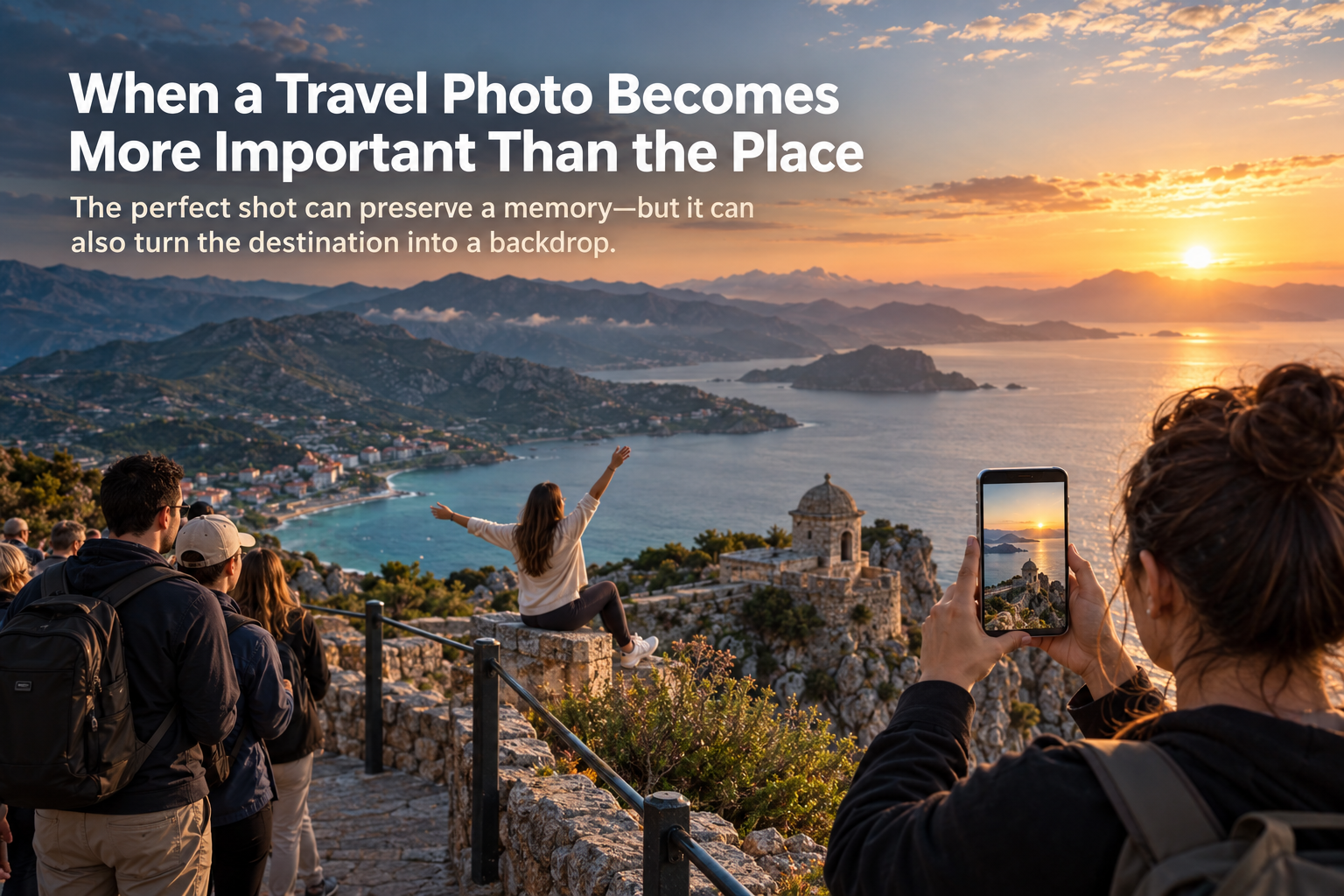

People are willing to journey thousands of kilometres to great destinations – but sometimes a reality check is in order. Visitors do not look at what\'s beautiful, but look for the perfect shot; wait for others to get out of the picture and try the same pose they\'ve seen online. The photo is the object, the place is the backdrop.
Travel photography has been a part of world exploration since the beginning. Cameras can capture memories, experience and details that would be lost if they didn\'t. However, the landscape of travel and photography has shifted with the advent of smartphones and social media. Famous places can be made famous from a single photo, and people can have an idea in their mind of what their own photograph will look like before they have even reached the destination. It\'s an interesting point to ponder: At what point does documenting a trip become more about enjoying the trip itself than just a way to document it?
Finding the ideal travel photo is an ongoing process
In earlier days, the only photographs used for travel were personal memories, family photographs and a few postcards. Now, an image can be disseminated to thousands of people in mere minutes. Social media platforms offer incentives to their users for sharing content that is visually appealing, prompting travellers to look for familiar landmarks, stunning landscapes, and well-crafted moments. This is now affecting how people get ready for a journey. Many tourists search for the most picturesque locations and book pictures of certain streets, and schedule their trips around places that have been posted over and over again online. It\'s helpful to know where to take a photograph, particularly if you\'re in a hurry. The issue starts when the desired image is more significant than the experience.
A tourist can spend the whole trip looking for a photo one individual took. This can be tricky due to lighting, weather and crowds and causes frustration and repeated attempts. The traveler\'s attention is drawn to the product, and he focuses on getting a result that will resonate with an online audience, rather than the environment of the place. The picture can be even a great shot, but the time around it can be rather empty.
Social media can turn any place into a backdrop

Certain destinations can now be instantly recognised via the visual language of social media. When many people post the same pictures in the same spot on a colourful staircase, restaurant or the dramatic view of a cliff, the place can go viral. When these images swirl round and round, they create expectations as to what a destination should be like. Visitors come to see the exact same scene they have seen on the internet but fail to notice the surrounding buildings and their history. The site is linked to one particular image, and not its other properties.
This can also impact company image. Hotels, restaurants and attractions can create spaces that appeal to the camera in the knowledge that visitors will be posting their photos online. This exposure leads to increased visibility for some places, and it can exert pressure on others to focus on visual attributes over less obvious ones. This leads to a new kind of tourism: sightseeing based on a photographic assessment of places. What may seem like an impressive-looking destination online can seem very mundane in real life, and vice versa.
When he says that he was there, he was actually there
The function of the photo is to remind people where they are and what they\'re doing. Sharing them can also be a way to keep friends and loved ones connected. But social media adds a new incentive; making photos of participation. To some travelers it can be a lack of a picture of the landmark to show their achievement. Just a picture of the trip helps to verify it and gives a tangible result to share. Otherwise, it can be hard to see how it\'s able to be passed down if it\'s not.
This pressure may be nuanced. One individual could arrive at a viewpoint and start taking out a telephone straight away, without even taking the time to check around. A meal can be captured in a picture before any one has eaten it, and a quiet moment can take the form of a content production. It\'s not a bad thing to share travel experiences. The problem is this: When the need for proof sets the standard for what to experience, it\'s hard. An enjoyable trip shouldn\'t need to be visually impressive to be worth taking.
This is an excellent question

If you have a lot of people taking the same shot, you can find yourself in the midst of a crowd at popular spots. A road can be packed with people waiting for an unobstructed view, and a picturesque point of interest can become a line of people waiting in front of the view. These crowds have a negative impact on visitors and residents. Valuable time can be lost waiting to see photos, and residents of nearby streets can find them busier than normal. Excessive noise, restricted access at front doors and over-use of photography in front of private houses can transform a common neighborhood into an informal studio.
The pressure is very apparent in areas where space is restricted. A narrow coastal path, old bridge or staircase may not have been intended for bussel traffic to stop and stay for a long time. If the visitor is only taking photos, it can be hard to move and safety concerns can arise. Some places have implemented visitor management systems, viewing zones or limits in sensitive areas. These are examples of a broader problem that is the issue of not blocking the use or experience of a place while the person enjoys and documents it.
Reading or hearing are both forms of seeing
A photograph captures a moment in time, but travel is more about so much more than just seeing. Sounds, smells, conversations, varying weather, physical exertion and random encounters. These are information points that often do not fit within a photograph, but can be the most impactful aspect of a trip. A traveller may be aware of the aroma of fresh bread from a bakery in the neighborhood, or the sound of a train passing or someone speaking directions. Moments like these can make a more emotional connection with a destination than a carefully composed image, and do not necessarily have to be captured in a social media post.
Photography can aid these experiences where it can promote closer viewing. It is possible to see patterns, textures and colours that may not be visible through the naked eye by viewing architectural details with a camera. A common moment can also be captured in a photograph and turn meaningful. It\'s a matter of attention. Taking a picture is a great way to help someone to appreciate a place, it adds to the experience. The process may block their perception of anything but what is on the screen, and this can remove something from them.
In essence, the Camera is a collection of memories

Photographs shape and preserve memory, as well as what is communicated. A gallery can transport you on a trip through time and spark up details that you might have forgotten. Images captured, however, tend to be what they thought was important to capture at the time. A traveller might have several photos of iconic sites, but neither many notes on their conversations or quiet strolls nor many records of their surprising challenges. These snapshots over time can become more salient to memory because they are easier to remember.
But it doesn\'t imply that the memories are untrue. Instead, the camera only records a certain amount. Focuses on what is within the frame and excludes the context around it. Some find this out when they go through an old vacation album. The pictures might capture a gorgeous scene, but the memories that come strongest to mind are of a missed train or saying a family dad-joke or waiting for the rain to pass for an afternoon. Often these experiences were trivial at the time, but they eventually became the main theme in the narrative of the journey. A travel photo can capture a moment but it can\'t hold all the meaning of a moment.
The Impact on Local Communities
If a site is deemed to be a "photographic hotspot", the impact can ripple outwards from tourism. It is possible for residents to encounter strangers outside of their residences, or enter their private property and take multiple photos of buildings without regard for the individuals living there. While the attention can be helpful for small businesses, the attention can also be helpful for local services and infrastructure. The streets are often designed for pedestrian traffic but can be overcrowded at times, and demand for housing can have an impact on community life.
The image of a location can also be streamlined. Visitors can admire a colourful wall or an interesting doorway, but without knowing anything about the community that created it. At times, the residents of these neighbourhoods are part of the background in a stranger\'s snapshot. Responsible travel means understanding that destinations are places where people live as well as places to see beautiful backgrounds. Small practices like getting permission before taking pictures of people, respecting private property and avoiding obstruction go a long way to help visitors and residents maintain the connection.
How to Make Travel Photography More Meaningful?

But it\'s not quite the end of photography in travel. Instead, visitors must change their thinking about what they want their photos to portray. Instead of just taking photos of well-known scenes, they can capture aspects that portray an atmosphere and the activity within it. A local market, old door, train platform or a table after a shared meal can convey a unique sign about a destination. This image may not be as readily identifiable as a popular landmark but can convey a more personal message. It can also be used to distinguish between the looking and the taking of a photograph. A few photos, then putting the phone down opens room to explore the environment without an ongoing evaluative lens.
Travelers can also make notes about what they saw, make a recording of a conversation or simply take a moment to pass without making a note. They offer alternatives to the journey and alleviate the pressure to make every experience shareable. The purpose is to not disparage the photographs, but to incorporate them into travel and not the impetus behind it.