


Travelers look for dates, compare airlines and hustle to get a seat before it is sold out. However, the opening booking fee doesn\'t necessarily reflect the cost to the passengers. Extras like seat choice, bags, food, payment and more can make all the difference. There are more than just flights that sell behind low-cost fares, there\'s a well-thought-out business plan.
How Airlines Make Low Fares Possible
Low cost airlines have revolutionized the aviation industry by turning the notion that flying has to come with a raft of services inside one ticket on its head. Many airlines provide a variety of different packages for passengers, allowing them to choose which ones they want to add on to their base fare. The customer pays for a seat up front and then determines if they need extra services or not.
In this way, airlines can promote a low initial price and still make a profit based on the price points and preferences of their passengers. An individual who is travelling for a weekend with a small bag might pay a relatively low price, whereas another passenger who is carrying several suitcases and might have a preference for a specific seat might pay a lot more.
Operating efficiency also comes to the fore. Airlines can cut costs by streamlining their fleets, onboard services, aircraft utilization, and by utilizing secondary airports if possible. The faster the plane can turn around the more time it will spend in the air and less time on the ground. Utilisation can be high, meaning that the cost of the aircraft and operation can be distributed over more flights.
Operating costs, however, don\'t necessarily equate to low fares in each category. Fuel and maintenance, airport costs, financing the aircraft and staffing and safety costs are still major expenses. The business model relies on managing costs but still making money from ticket sales and ancillary services to make each route profitable.
The starting price is a psychological concept

The first price they are shown on their journey can make the whole booking decision. If the fare seems abnormally low, users might start to make plans around it before calculating a complete fare. One of the reasons head-line prices can be so effective in travel advertising.
The low fare puts a benchmark in place. After someone has envisioned the possibility of flying for a certain distance, the additional cost of a favorite seat or an extra suitcase might not seem as relevant as the cost of the ticket in itself. The passenger no longer has to compare the total cost of the trip to all the other options, they might be comparing each extra fee to the low price that appealed to them in the first place.
Short-term sales and the dissemination of information about the availability of seats can create urgency. Customers might fear they\'ll miss the deal if they wait and review all the conditions, as they may be tempted to book it. True price changes as availability fluctuates, but urgency marketing can make comparison more challenging.
The take away is simple: The headline fare is merely the starting point. The meaningful figure is the actual traveler\'s total fare for the trip he or she takes.
The business of the bag is evolving
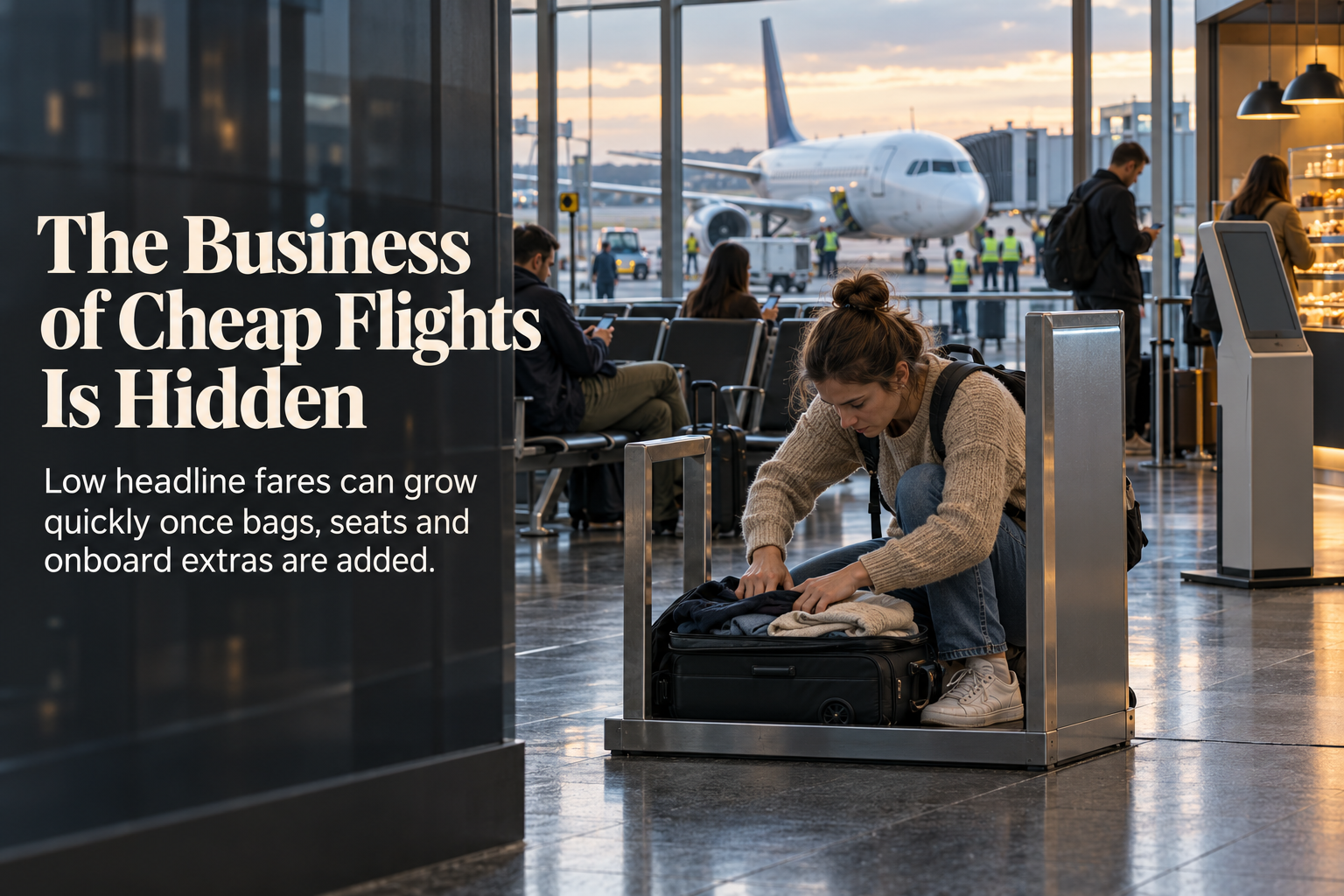
One of the most obvious ways to generate extra income for the airlines is by handling baggage. Many low cost airlines impose a limit on the personal item, and may charge additional amounts for larger bags and checked items. Rules vary from airline to airline, ticket to ticket, route to route and therefore allowances are important to know before departure.
Airlines have a number of reasons for charging for bags. It provides extra revenue, makes passengers switch to lighter loads and can make aircraft loading easier, if policies are enforced consistently. Operational considerations include weight and space, especially on aircraft with limited cabin space.
But a comparison of baggage fees can be confusing for passengers. One airline could have a higher up-front cost but offer a larger cabin bag, another could be cheaper but charge separately for the same bag allowance. The latter may be even cheaper, but only once the traveller has worked out the expenses.
Travellers will need to consider the size and weight limitation. A bag that meets the definition of "cabin luggage" can be too large. The rules are not something you want to be surprised by so it is important to know them early on or you may have to pay more fees on the spot at the airport.
How to pick seats that cost more

The ancillary revenue model has taken on another significant aspect with the consideration of seat selection. Some airlines take passengers\' seats automatically, others charge to those who prefer to sit in a specific seat. Some preferred seats, front row seats and extra legroom seats can be more expensive.
It enables airlines to offer various degrees of convenience in the same cabin. If a person wishes to depart the plane quickly, they might be prepared to pay for the additional legroom to the front of the aircraft, but if they are taller they might be willing to pay for extra legroom.
A more complex choice can be required for families. It might not be as optional to opt for parents sitting together with young children, and the option to be separated may make paid seat selection more of a necessity. Each airline has its own rules and policies in family seating, so it is best to check the conditions rather than just assume.
It\'s a business opportunity that is obvious: airlines can increase their revenue from preferences that were no longer an integral part of the total fares. The key is to make sure customers know what they are getting and which options will incur more cost.
The meals are served and the drinks are served
Airlines also offer various items of food and drinks. Refueling is provided on certain routes or fare categories, or meals and beverages can be purchased. They can also upgrade their ticket to include priority boarding, WIFI access or other onboard amenities (if available).
These services are being sold separately, providing airlines with a bit more freedom. If passengers do not wish to eat a meal, this does not require them to pay for a meal as part of the bundle, and those who prefer the extra comfort can opt to pay more for it.
But not all services are equally enticing at all points along a trip. A short trip might need more than just a seat, while a longer flight might need more than just a seat, food and entertainment. The worth of every add-on varies depending on the length of time of flight, the needs of the passengers, and what choices exist.
To avoid over-spending, travelers should find out what is included and what they are allowed to bring, and ensure they know what they really intend to make their trip more comfortable with.
The price of airfares is adjusting on a constant basis

The cost of airline tickets is usually subject to change. Revenue management systems help carriers to make pricing decisions based on the levels of demand, available inventory, booking trends, travel dates, and other business considerations. The goal is to sell enough seats for highest possible total revenue, but have as many paying passengers on the airplane as possible.
Prices for seats booked months before a flight can vary when it comes to full flights. Saturations can occur during popular holiday periods or during busy travel times, which will raise the demand, and reduce the fare during less busy periods. Also, the competition in a specific route can affect pricing.
There\'s no universal rule that having to book at a certain time of the week will always give you the cheapest fare. The most optimal time to purchase will depend on the route, season and capacity/market.
Increased chances are possible by researching multiple dates, when applicable, locating other airports in the area to look into, and looking at the entire fare quote instead of just a single result. Variability in planning may provide additional opportunity for an appropriate price, but there is no guarantee of savings.
Choices made at the airport are important
There are also some low-cost airlines that fly from an airport not in the main city center. They can also have reduced operating costs or more favorable terms for the airline, which help to maintain competitive pricing. However, the cheapest airline ticket might not be the lowest cost trip.
A long journey to an airport will add to your expenses, whether traveling by train, bus, taxi or sleeping overnight. Travelers might also have to depart earlier and take more time for ground transportation. Getting to the airport can be a significant portion of the travel budget if there is not a lot of public transport available.
Convenience as well as cost can be affected by the choice of airport. It could save you hours of travel and the possibility of missing an air flight and it is a bit more expensive from a nearby airport. The cost of ground transport can easily escalate for a family or group.
The ticket cost and the cost of the bags, transport to and from the airport, arrival provisions, and overnight expenses should therefore be included in a useful comparison. No, the best option is not always the first one on the first page of results, it\'s the one that offers the greatest value.
What if Things Go Wrong?

When everything is running smoothly, low fares are most attractive. All of this adds up to the overall disruption, and can make a trip significantly more expensive, especially if a passenger has booked separate flights, accommodation or ground transport.
It is advisable for travelers to know the airline\'s policy and what they are entitled to on the particular route. Depending on the circumstances and the rules applicable, the passenger may be entitled to assistance, refunds, rerouting or compensation. What this protection means differs, so don\'t assume that all disruptions have the same effect.
Having separate bookings can introduce extra dangers. A delay on the first leg of a flight might mean a second leg is missed if the passenger has arranged the two legs of a flight independently with only a short gap in between, and not the same type of protection that would be available if the two legs of a flight were booked as a single connecting itinerary.
Depending on the travel insurance policy and the type of coverage you have, it might cover some of the unexpected costs. It\'s better to check the conditions before buying coverage, rather than expecting that any delay or cancellation will be covered.
Are low-cost flights really cheap?
With low-cost flights, people may have thought that flying was too costly for them in the past. They have flexible pricing options so that passengers pay for services that are necessary to them and do not pay for services that they need. If you\'re a light traveler with flexible dates a low-cost fare may be good value.
Issues come when the price advertised is considered as the final price. Other charges, less convenient airports and repercussions of disruption can alter the calculation. There may be some extra fees that are not unreasonable, but consumers are unlikely to be able to make an objective comparison of offers if they lack clarity on fees.
The best way to do this is to compare apples to apples. Travelers should work out the total amount they need for their trip, look into any limitations, and think about convenience while booking their travel. A higher charge might be better value if it covers the necessary amount of luggage and/or is run from a more convenient airport or has a better timetable.
There is much more to the story behind ‘free\' flights than selling tickets for cheaper rates. It\'s about de-segmentation, price changes and letting passengers choose where to spend their money. Knowing that means that travelers can take advantage of the competitive prices but without the distraction of the price tag. Finally, the wisest booking isn\'t necessarily the lowest cost ticket. It\'s the ride that provides the perfect blend of affordability, comfort, flexibility and dependability.