

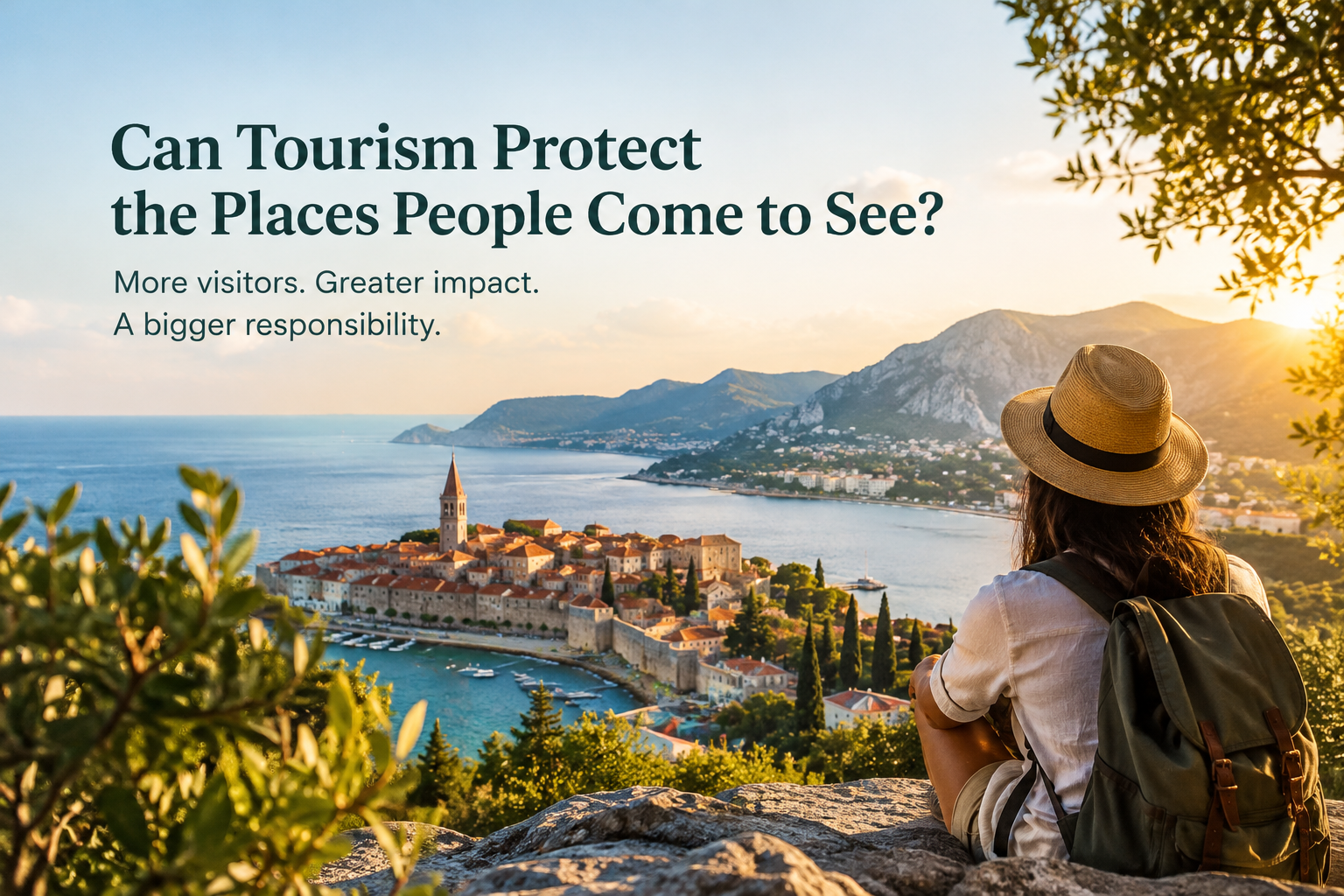


People come to experience and admire the historic cities, national parks, beaches and cultures other than their own. However, the very tourism that attracts visitors can be the cause of the problems that endanger the attractions themselves. However, the places that people enjoy can become different over time, as crowded streets, broken ecosystems, and high housing prices and strain on local resources slowly alter the environment. This brings up a crucial question for the tourism sector: can increased tourism also be a means of safeguarding destinations, or are they always at risk?
Do you ever find that you are too popular?
A successful tourist destination can go through a challenging balancing act. The more people who visit, the more money, work, and opportunities are generated by local businesses, but the more people that visit, the more need there is for transportation, lodging, water, waste disposal and public spaces. As the numbers of visitors increase more than the local infrastructure can take, the effects are apparent.
Busy pedestrian walkways and congested traffic in historic city centers can be a problem, as can be the growing number of short-term rentals and tourist-oriented businesses in residential neighbourhoods. Too many people in natural areas can cause damage to the vegetation, to wildlife and to soil erosion. Beaches and coastal locations can be vulnerable to litter, pollution and impacts to sensitive marine ecosystems.
Not all these issues exist in all destinations in the same manner. Their impact is dependent on the numbers of visitors the site sees, planning on the site, infrastructure and the local environment. A city that\'s well-equipped with public transit and robust visitor management can handle many more than a small island that\'s resource-constrained.
Rather, it is not just about reducing tourism everywhere. To understand the level of visitor usage that will not compromise the environmental, cultural and social attributes that make a place attractive to visitors.
Visitors can pay for conservation

Tourism can cause environmental harm, but can also generate funds to do the job. National parks, heritage sites and conservation areas need investment for maintenance, research, conservation and the provision of trained staff. When a fair share is achieved, spending by visitors can help support these activities.
Protected site entrance fees, for instance, can help to sustain trails, wildlife and waste management. Trained local experts can offer guided tours which help visitors learn about the importance of protecting certain areas and generate income. For historic cities, museum tickets and culture can contribute to the preservation of buildings, collections and traditional activities.
But the link between tourism income and conservation is not without doubt. Funds from the visitors are not guaranteed to go to environmental projects or communities. Funding should be clear and there should be a determination of how the revenue will be shared between destinations.
If visitors are able to see how their expenditure helps to protect a place, then tourism is not just a business transaction. It can be connected to a system which can support the long-term future of the destination.
Protecting Nature While Welcoming Visitors
It is the natural landscapes which are among the strongest reasons for people travelling. The mountains, forests, wetlands, coral reef and wildlife reserves draw tourists looking for experiences that can\'t be found elsewhere. However, they can be especially susceptible to the impacts of poorly managed tourism.
People walking around can widen walking tracks, wild animals will change their behavior if they are approached again and again, and boats can disturb sensitive marine habitats. Some places may also experience additional pressure due to water use by hotels and recreational activities.
These effects can be minimized by implementing protection. Destinations can establish paths and zones for specific activities, a limit on the number of visitors to sensitive areas, and seasonal closures and restrictions on activities that disturb wildlife. Improved waste management systems and responsible transportation methods can contribute to the reduction of the environmental impact of tourism.
Education is also important. Rationale for keeping animals at a distance, not disturbing natural materials and not straying off marked trails is more likely to result in responsible behavior. Local guides are able to discuss these restrictions in context and make them an opportunity to learn about the environment.
However, good behavior will not fix all issues. Demand for infrastructure and resources still occurs from even the careful visitor. The successful conservation needs planning, monitoring and enforcement, as well as awareness.
Preserving Historic Places is an expensive business

Other pressures are placed on historic places. Large numbers of people passing through the old streets, monuments and traditional neighborhoods each day were not always a design consideration. These can become degraded by heavy use and commercial development can alter the character of areas that used to be used by local communities.
Tourism revenue may fund the restoration of historic buildings and help to preserve museums, but it can also be used to promote the kinds of facilities that will attract tourists rather than the needs of the residents. Local businesses can be replaced with souvenir stands, and local services may not be able to compete with those that cater to tourists.
Preservation involves more than just the preservation of attractive façades. This includes safeguarding the social and cultural vitality that makes a place special. People must be able to live in the house, use the transport, shop in the shops and use the public spaces and local traditions must not be staged for tourists only.
Historic sites are not only places for photos but are also places of living communities. Arts and cultural heritage are more likely to be sustained in the presence of tourism if there is a direct role for local communities in planning and development, and in the management of cultural spaces and their access to visitors.
Yes, local communities can benefit
Local communities\' experiences of tourism are an important factor in the long term success of tourism. Hotels, restaurants, transport operators and tour operators could employ people, but the benefit to the economy might not be experienced by everyone. However, if many of the earnings of the destination are lost to external organizations, then local residents may be left with the burden of the costs of tourism without sharing the benefits.
By supporting local businesses, residents can help to retain more money in the local community. Local lodging is available, and visitors can buy local products, hire guides who know the area and its history, and visit the area\'s environment. Choices do not overcome all structural issues, but they can boost businesses that are tightly embedded within the local economy.
Governments and the tourism operators have a responsibility as well. Employment opportunities should be available on an equitable basis; development planning should take into account local needs; and communities need to be engaged in the planning of large tourism developments. If tourism is causing an increase in house prices or on-demand pressure on public services, then it may be necessary to plan and regulate.
This happens unless a destination\'s residents feel a sense of belonging to the industry created around their home. The protection of a place is the protection of the people who make it what it is.
How many visitors can be accommodated?

For a popular site, one of the toughest choices is how many visitors the site can handle. While restricting access can help to protect sensitive areas, it can also lead to a decline in earnings for businesses that rely on tourism. It could boost short-term returns but also raise environmental and social costs that will be more difficult to undo.
Various destinations may implement various strategies. Timed entry can help to disperse visitors over the course of the day, and the use of reservation systems can ensure that overcrowding at sensitive sites is avoided. Certain areas may be closed for short periods of time during certain seasons to benefit the ecosystem. Others can inspire visitors to different neighborhoods or to travel at less busy times.
A reliable visitor management system isn\'t just a guess, it\'s based on facts. Authorities require information regarding environmental conditions, infrastructure capacity, resident concerns and seasonal demand. Also, measures need to be constantly evaluated in view of the changing demands of a destination as tourism develops.
Changing one\'s direction to a lesser known location is not always the answer. A small town or natural area may not be able to handle an influx of visitors. The distribution of tourism is optimal if alternative tourism destinations are equipped with infrastructure, planning and resources to manage them in a responsible way.
What is their role?
Governments and businesses are not the only ones responsible for tourism protection. The travelers are the agents who have an impact on destinations through their spending, behavior and expectations. Using public transport if possible, adhering to the rules of the land, minimizing waste and avoiding activities that may negatively affect wildlife can make a difference.
Planning also matters. Visiting during non-rush hours may help alleviate some stresses, as may spending more time at a destination and getting to know the local customs. A longer stay could diffuse money spent at the resort into area businesses, but the total effect would still be based on where people went to stay, how they got there and what they did there.
While travelling, it is important to also be aware that not every product labelled as sustainable truly has an environmental impact. Having an eco-label or responsible travel message doesn\'t guarantee that a business maintains a healthy habitat, is fair with their employees, or is an outstanding waste manager. It is more helpful to have a clear understanding of actual practices rather than marketing-speak.
It is all very well to have individual choices, but when the wider use of infrastructure and policy decisions are being considered there are limits. However, where knowledge of these issues has been raised, a traveler can reward responsible operators and contribute to the development of demand for tourism to be more responsible about protecting destinations.
Technology and Better Tourism Planning

Technology can provide a means for destinations to become aware of and be able to control visitor activity. The access of popular attractions can be managed by booking systems and timed tickets and the movement of visitors can be used to find out when certain streets, trails or transport services are over-stressed. Digital information can also help travelers to avoid the busiest times and inform of temporary closures.
Environmental monitoring can be used to aid the management of protected areas for tracking changes in water quality, wildlife activity or visitor impact. If these data are used properly, they can be used to help determine problems in advance of them becoming serious. But technology can\'t stand for good governance. Visitor data should be treated with great care, privacy acknowledged and decisions made based on local experience as well as numerical indicators. A successful destination could be defined as one with growing visitor spending, but increasing cost for residents and less access to public space.
Systems that are the most helpful have clear objectives and reliable information. The questions of tourism pressure can be answered with technology; however, there is still a need to make choices on what is worth protecting and what is acceptable as a trade-off.
There are multiple models of tourism, not a single one
Sustainability in destinations calls for a change in the way success is measured by the number of visitors. Arrivals and spending are also valid economic indicators but can\'t tell you if the environment is going downhill, people are being displaced or cultural heritage is losing its meaning. A more comprehensive perspective would include a consideration of the condition of natural habitats.