
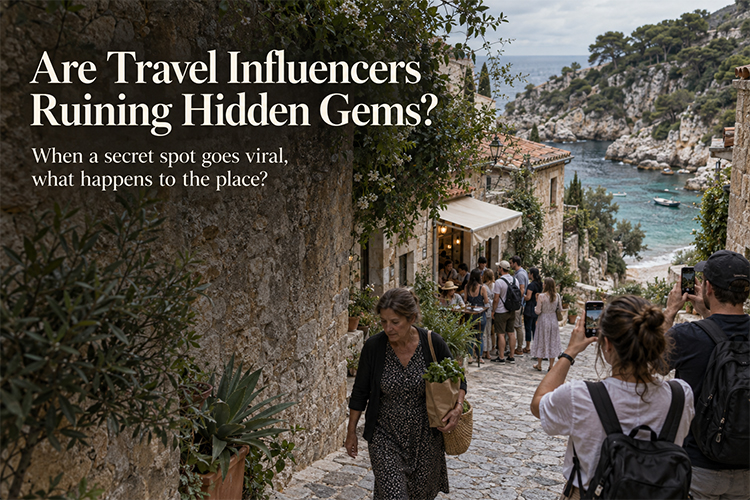

A deserted beach, a humble little restaurant on a side street, a little village not on every tour itinerary and a local viewpoint. Someone then put it up on the internet. The video became a viral sensation. It was a viewing event for millions! Then, the “hidden gem” got a location tag, a trending hashtag and a line that went around the corner. Now it is possible to discover places in a way that has been transformed by social media, and the world is easier to explore than ever before. However, it also has raised an uncomfortable question for those who travel today: When everyone finds out about a hidden gem, is it hidden anymore and what happens when everyone begins arriving?
The Moment a Secret Becomes a Destination
The need to find somewhere special isn\'t a travel influencer thing. They did not change the content of a place but how fast a place can go to become famous. What used to take years to get noticed can turn into a day\'s news in no time. You can draw millions of visitors to a little café, a solitude spot on a distant beach, a hiking trail or a quiet village by making just one beautiful Reel or TikTok.
This can be exciting for travellers. Suddenly, you come across an unknown location on your feed. You see a location on your feed that you had never heard of. A family-run restaurant that you haven\'t seen in the guidebooks and a neighborhood that is quite different from the usual tourist itinerary. Social media has made it available to people who would never be able to find these places without it.
However, popularity brings with it a cost. The exposure that introduces a destination to the world can, over time, alter the thing that attracted them to the site.
What if everyone wanted the same experience?

The “hidden gem” is that its value is often tied to the very fact that it is hard to locate, namely, fewer people! A back beach is a back beach because it is unobtrusively quiet. When you have a chance to sit quietly in a small café, it feels special. If you\'re not walking behind hundreds of others, a peaceful hiking trail is peaceful.
Once a place starts to become a viral place, things can change rapidly. Parking can be challenging, local businesses can become overcrowded, costs can go up, and waste can go up. The abrupt surge in numbers can be problematic on roads, in public areas and in the natural environment.
Over time, the destination of people who came to get away from the crowds can turn into another tourist hotspot. This contradiction may not be obvious to the algorithm. It does view, share, save and comment. It doesn\'t automatically realize the effect those numbers may have on a real community.
The Algorithm loves beautiful places
Social media is paying attention to content that makes people pause their scroll. A turquoise lake, a road with a majestic mountain in the background, a little old European street, a hidden waterfall or a small restaurant with an outstanding view can make any scene very interesting. The more dramatic the location, the more likely it is to make a good story. A creator finds a lovely place and publishes it. The audience saves and shares the video. Other creators visit due to its visibility online. Far more is created, and far more people find out the location. The very near future will see the area no longer just as a “destination.” It\'s a trend. Trends don\'t get smaller; they get bigger.
Is it really the travel influencers who are the problem? This is where it gets more complex. While travel influencers can be a contributing factor to the sudden surge in visitors, they are not the only players to play a role in the future of tourism. Where people go is determined by tourism boards, travel platforms, airlines, search engines, recommendation algorithms and even ordinary travelers.
Exposure has a positive side as well. A restaurant that is owned by a family can attract more people. New income can be brought to a rural community. A less-familiar place can be an investment opportunity and job generator. Restaurants and other small businesses that had a hard time attracting international guests can now attract customers from around the globe.
In some places, it\'s not the unknown that\'s the issue

What happens when sharing is overexposure? What if sharing is too much sharing? It\'s an increasingly relevant question as to how much information travelers should share. Would you tell me the secret of a beautiful place? Should the little restaurant be tagged? If you know of a quiet swimming spot, with only a few people using it, will you be willing to give away the coordinates?
There is no single correct answer! Some creators feel that sharing is the best way to benefit local communities with tourism. Others say that there are some fragile environments and overcrowded locations that shouldn\'t be exposed any more. The context matters. A struggling natural environment with small capacity is not the same as a small restaurant that is actively seeking customers. So treating every beautiful location as content can, with impunity, overlook that difference.
It seems that maybe we have the wrong definition of a hidden gem. Perhaps we do have the wrong definition of “hidden gem.” Maybe visitors have to change their perspectives. The goal doesn\'t necessarily have to be finding somewhere that nobody knows about. Instead, it might be a location that hasn\'t been overrun yet.
It could be travelling outside of rush hour, spending more time in a specific area, visiting neighborhoods outside the popular tourist areas and supporting the local economy instead of only the popular tourist areas.
It might even involve a ban on cell phones
Let\'s face it, sometimes the best trip is not the one that\'s got the best online reviews. It\'s where you don\'t always find yourself asking, "What is it about that thing, but that thing that I see is different from that thing I see in the video? In today\'s world, every trip is expected to be a content opportunity. In this day and age, all trips should be content opportunities!
Another paradox of modernity when it comes to travel. We are looking for authentic experiences, but also for photos of these experiences. We desire quiet places, and we tell people about them. We don\'t want to be around a lot of people, but we often do the same thing as millions of other people.
Social media has made the experience of a destination and documenting it seem indistinguishable. Sometimes we get there and just start to think about the photograph, the Reel or the caption rather than just being present. But that doesn\'t mean the travelers should put down their cameras or the creators stop sharing their experiences. It just poses a bigger question: Should every beautiful place be the next viral destination?
Avoid consuming the destination on your trip

It\'s never been easier to explore the globe thanks to travel influencers! Now the trick is finding a way to find it, without eating it.
A viral post can motivate someone to take a flight. One of the most fun aspects of travel content. However, travelers responsibility starts once they have booked. Respecting local communities, following environmental guidelines, supporting local businesses and understanding the limits of a destination is a difference-maker.
A Reel doesn\'t just take place against a backdrop. It is someone\'s home, someone\'s livelihood and sometimes an ecosystem that took thousands of years to develop. The future is uncertain. What lies ahead is open to speculation.
In the age of hyperconnectivity, the concept of a completely untouched region might be becoming harder and harder to come by. New technology like satellite maps, travel apps, social media and online reviews has made it easy to locate virtually everything. That doesn\'t mean that hidden gems are going away, though. They might just be changing up their outfit. The secret beach or the untouched viewpoint of tomorrow may not be one you haven\'t thought of. It may be a neighborhood that you need to discover, a local market that you find by chance, a small town that you stay at for a week rather than just an afternoon or a restaurant that is recommended by a person you meet during your trip. The secret place you go to may be more about how you get there.
It might not be the discovery that\'s the issue
Travel influencers have revolutionized how people find places, and that\'s not a bad thing. They can be the gateway to the communities, cultures and businesses that may not be discovered otherwise. The true question is: What happens when discovery becomes mass tourism overnight? Maybe it\'s not about fewer travel stories. We just need more thoughtful stories of what it\'s like to appreciate a beautiful place, and how. The irony of the hidden gem is that we risk the very thing that made me want to go there if we turn all the secrets into content.